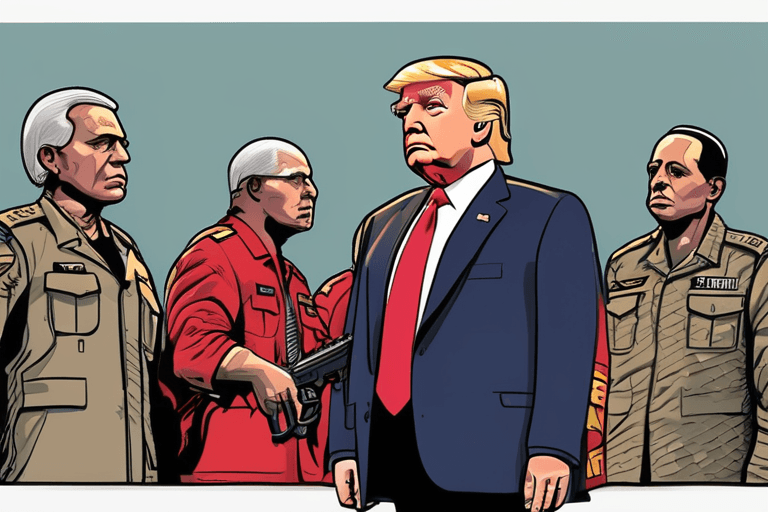
President Trump, who previously criticized regime change and nation-building efforts, stated that the U.S. is "in charge" of Venezuela, marking a shift in his administration's stance. This declaration, made public on January 5, 2026, raises questions about the evolving role of the United States in international affairs and the potential implications of AI-driven policy decisions.
Trump's statement, captured in an audio recording aired on NPR's "All Things Considered," directly contradicts his earlier pronouncements against interventionist foreign policy. "We're in charge," Trump asserted, without elaborating on the specific actions or strategies that underpin this claim. The White House has yet to release a formal statement clarifying the extent and nature of U.S. control in Venezuela.
The apparent policy shift comes amid growing concerns about the humanitarian and political crisis in Venezuela, which has been exacerbated by economic instability and authoritarian rule. The U.S. has long been involved in the region, primarily through economic sanctions and diplomatic pressure aimed at promoting democratic reforms. However, the explicit assertion of being "in charge" represents a significant escalation in rhetoric and potential involvement.
Experts in international relations suggest that this change in tone could be influenced by AI-driven analysis of geopolitical data. Advanced AI systems are increasingly used to predict political instability, assess the effectiveness of sanctions, and model the potential outcomes of various intervention strategies. These systems can process vast amounts of information, including social media trends, economic indicators, and intelligence reports, to provide policymakers with data-driven insights.
Dr. Anya Sharma, a professor of political science specializing in AI and foreign policy, noted that "AI could be presenting scenarios where a more assertive U.S. role appears to yield the most favorable outcomes, even if those outcomes involve risks associated with interventionism." She cautioned, however, that "relying solely on AI-driven recommendations without considering ethical implications and local perspectives could lead to unintended consequences."
The use of AI in foreign policy decision-making also raises concerns about transparency and accountability. It is often difficult to understand the complex algorithms and data sets that inform AI-driven recommendations, making it challenging to scrutinize the rationale behind policy choices. This lack of transparency can erode public trust and make it harder to hold policymakers accountable for their actions.
The situation in Venezuela remains fluid, and the long-term implications of the U.S.'s declared control are uncertain. The U.S. State Department is expected to release a detailed policy statement in the coming days, outlining the specific measures and objectives associated with this new approach. The international community is closely watching to see how this development will affect regional stability and the prospects for a peaceful resolution to the Venezuelan crisis.















Discussion
Join the conversation
Be the first to comment